


Learning UX can feel overwhelming.
There are dozens of design principles, usability heuristics, psychological concepts, and frameworks to remember.
Most learners try to memorise them.
That’s the wrong approach.
Great designers don’t memorize every UX Law.
They recognise patterns and know which principle to apply at the right moment.
That’s why we’re launching Free Resource Wednesday.
Every Wednesday, we’ll publish one practical resource designed to help UX designers learn faster and work smarter.
This Week’s Resource
UX Laws Cheat Sheet
This guide brings together some of the most important UX principles used by product designers every day.
Inside you’ll discover:
- Hick’s Law
- Fitts’ Law
- Jakob’s Law
- Miller’s Law
- Tesler’s Law
- Doherty Threshold
- Aesthetic–Usability Effect
- Peak-End Rule
- Serial Position Effect
- Law of Proximity
- Law of Similarity
- Law of Common Region
- Occam’s Razor
- Parkinson’s Law
- Pareto Principle
Each law includes:
- A simple explanation
- Why it matters
- Where to use it
- A practical example
- AI prompts to help you apply the concept in real product design scenarios
Why We Created This
At UX Crumbs, we believe learning should be practical.
Instead of collecting theory, we want designers to build habits they can use in interviews, portfolio projects, and real product teams.
That’s why every future resource will focus on action, not just information.
What’s Coming Next?
This is only Resource #001.
Upcoming editions include:
- Gestalt Principles
- UX Research Methods
- UX Metrics
- Accessibility Checklist
- UX Writing Guide
- Design Systems Handbook
- UX Portfolio Framework
- AI Prompt Library for Designers
- UX Interview Guide
- Product Thinking Frameworks
By the end of the year, our goal is to build one of the most practical free UX resource libraries available.
Download the Resource
👉 Download UX Laws Cheat Sheet
About UX Crumbs
UX Crumbs is an AI-powered learning platform helping designers build practical UX skills through structured lessons, real-world challenges, AI coaching, portfolio guidance, and interview preparation.
If you’d like early access to the platform, you can also join our waitlist.
 UX Crumbs Team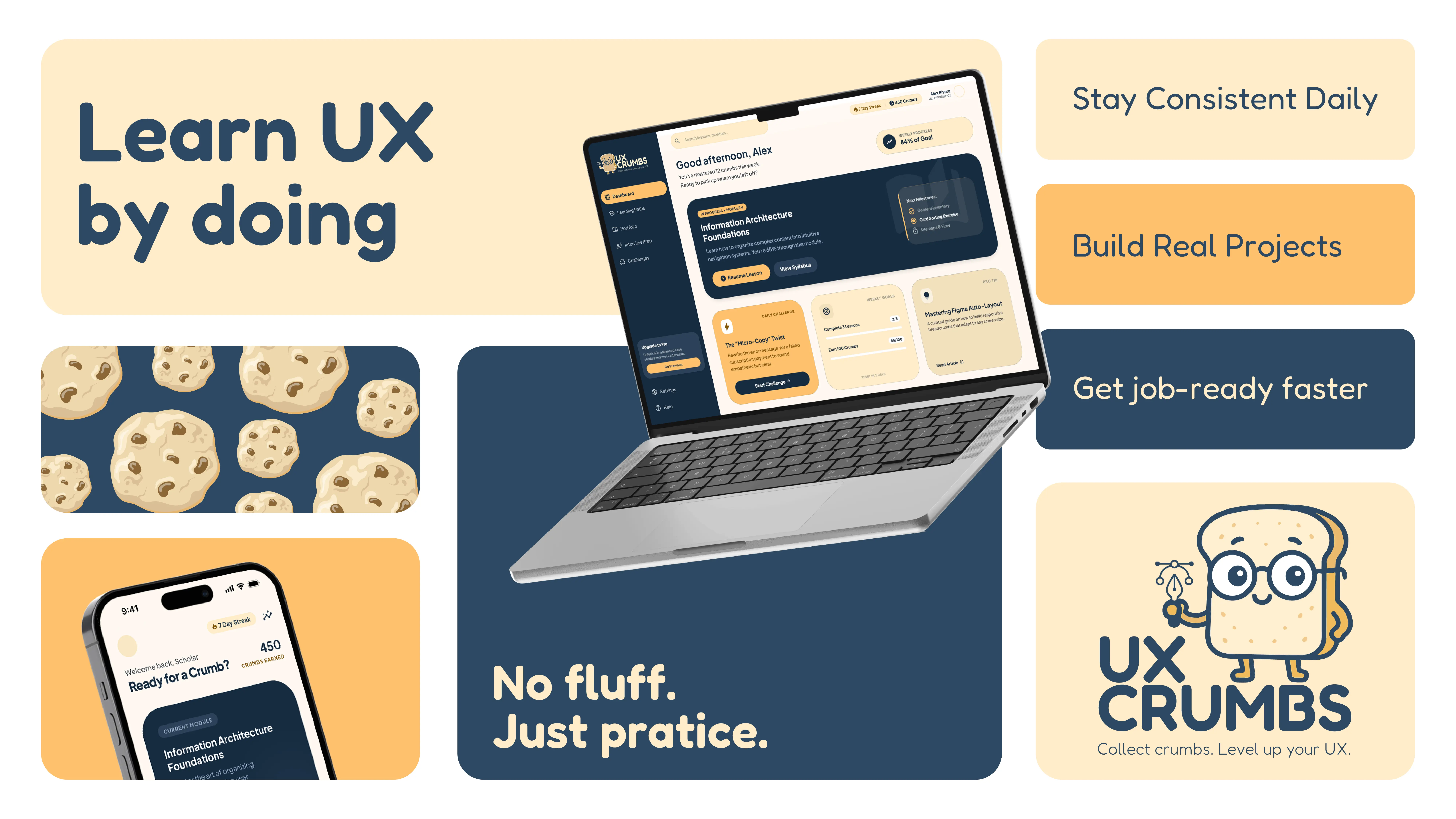


Comments